A legitimate online deal comes from a real business with transparent pricing, secure payment options, and a clear return policy. The difference between a genuine offer and a scam often comes down to whether the seller is willing to stand behind their products.
When you’re shopping online, legitimate deals share common traits. The website uses secure connections (look for “https” in the URL). The business displays clear contact information and a physical address. Prices seem reasonable compared to other retailers selling the same items.
At Mega Picks Oasis, we carefully select and test every product before offering it. This commitment to quality means you can trust the deals you find.
Scammers often use urgency as a tactic. They claim an offer expires in hours or show fake stock warnings. Real businesses don’t pressure you this way. They’re confident their products will sell on merit alone.
Pro Tip Check the domain name carefully. Scammers sometimes use URLs that look similar to famous brands (like “amaz0n.com” instead of “amazon.com”). Hover over links to see the real destination before clicking.
How to Spot Fake Online Stores Before You Buy
Identifying a fake online store takes practice, but several warning signs appear consistently. Start by examining the website’s design and professionalism. Legitimate retailers invest in clean layouts, working search functions, and professional product photos.
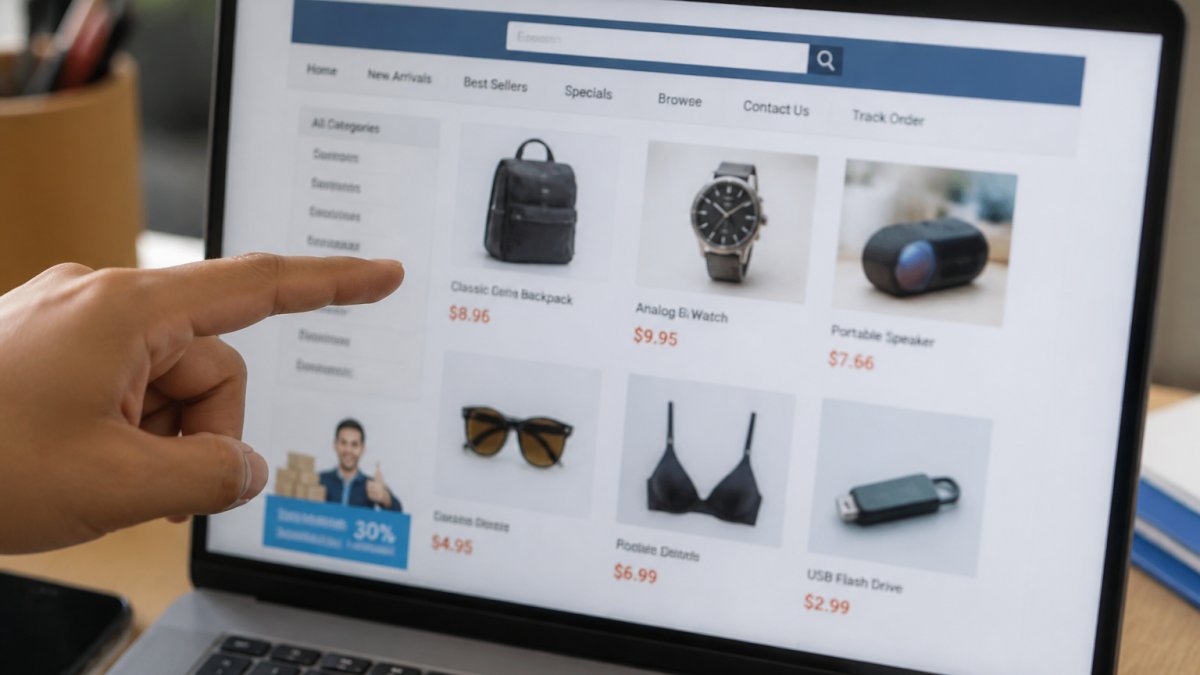
Close-up of a computer screen showing a suspicious online store website with poor design, blurry product photos, and warning signs visible, person’s hand pointing at the problematic elements
Check for these red flags:
Spelling and grammar errors throughout the site
Extremely low prices with no explanation
Generic product photos (often stolen from other websites)
No customer service contact information
No physical address or only a PO box
Payment options limited to wire transfer or cryptocurrency only
Website feels rushed or incomplete
Real online stores answer questions. They provide detailed product descriptions. They explain shipping times and costs upfront. Fake stores keep information vague.
Look at the website’s age. You can check when a domain was registered using free tools available online. Brand new domains selling high-ticket items are more suspicious than established ones. This doesn’t mean all new stores are fake, many legitimate businesses launch fresh sites, but it’s one data point to consider.
Watch Out If a deal seems impossible to pass up, pause and verify before buying. Scammers specifically target deals that trigger excitement over caution. The consequence of ignoring this instinct could be losing your money with no recourse.
How to Verify an Online Retailer’s Reputation
Before spending money with any online retailer, invest five minutes in verification. This step prevents most purchase disasters.
Start with the retailer’s official website. Look for an “About Us” page that explains the company’s history and mission. Real businesses tell their story. They explain why they exist and what they stand for.
Search the company name plus “reviews” or “complaints” in your browser. Read what actual customers say. Pay attention to patterns. One negative review doesn’t mean much. Five reviews mentioning the same problem (like packages that never arrive) tells you something real.
Check independent review sites and community forums. These spaces let customers speak freely without the retailer controlling the narrative. You’ll find honest feedback here, both positive and negative.
Look for business credentials. Many legitimate retailers display certifications or memberships. The Better Business Bureau maintains complaint histories. Some retailers carry trust badges from security companies. These aren’t foolproof, scammers fake these too, but they’re worth checking.
Ask yourself: Does this retailer make sense? If you’ve never heard of them, search their name with “legitimate” or “scam” to see if others have raised concerns. Trust your gut. If something feels off, there’s usually a reason.
How to Compare Prices Online Across Multiple Sources
Comparing sticker prices is the fastest way to get fooled. Two listings can show the same number and still differ by a wide margin once shipping, sales tax, fees, and return costs are added. The goal is to compare total landed cost, the amount that actually leaves your account, not the headline price.
Build a landed-cost column for every offer
For each seller, write down these line items before you decide:
Item price, the advertised number.
Shipping and handling, including any surcharge for expedited delivery or oversized items.
Estimated sales tax, most states now require online sellers to collect it; the rate depends on your shipping address, not the seller’s location.
Mandatory fees, restocking, processing, or “service” fees that only appear at checkout.
Return cost, who pays return shipping, and whether a restocking fee applies.
Membership or subscription cost, a “free shipping” perk is only free if you were already paying for the membership.
Add those rows and the cheapest-looking listing often stops being the cheapest. A common pattern is a lower item price paired with paid return shipping, which erases the savings the first time something doesn’t fit.
Use price history, not just today’s price
A discount is only real if the “original” price was actually charged. Before trusting a crossed-out number:
Check a price-history tool or browser extension that tracks a product page over time. If the price sat at the sale level for months, the discount is theater.
Look at the manufacturer’s suggested retail price on the brand’s own site. Some retailers inflate the “compare at” figure above MSRP to manufacture a bigger percentage off.
Note seasonal timing. Electronics, apparel, and home goods follow predictable markdown cycles around major shopping holidays, so a “limited” sale that recurs every quarter isn’t urgent.
Normalize the units
Retailers mix units to make math harder. Convert everything to a single measure before comparing:
Per unit, divide total cost by the number of items.
Per ounce, per pound, or per count, for groceries, supplements, and household goods.
Per month, for subscriptions and service plans.
A bulk pack with a higher total can still win on a per-unit basis, and a subscription with a low monthly rate can lose once an annual commitment or cancellation fee is included.
Verify the comparison, don’t just trust the tool
Comparison sites and shopping aggregators are useful starting points, but their feeds go stale. Prices change, stock sells out, and sponsored placements push certain sellers to the top. Open the seller’s own product page in a second tab and confirm the price, the shipping estimate, and the return terms directly. If the aggregator’s number and the seller’s number disagree, trust the seller’s page.
Pro Tip Keep a simple spreadsheet with one row per seller and columns for item price, shipping, tax, fees, return cost, and total. Sorting by the total column takes seconds and removes the emotional pull of a low headline price.
Key Takeaway The real question is never “which listing shows the smallest number?” It’s “which seller delivers the item I want, on the timeline I need, at the lowest total cost I can actually recover if something goes wrong?” Answer that and you’ve separated a genuine deal from a decorated one.
Best Websites for Online Deals Worth Your Time
Not all deal sites are equal. Some aggregate genuine offers from real retailers. Others promote mediocre deals with inflated original prices to make discounts look bigger.
Focus on established marketplaces with strong reputations. These platforms vet their sellers and enforce standards. They offer buyer protection if something goes wrong. Major e-commerce platforms have teams dedicated to removing fraudulent sellers.
Community-driven deal sites work differently. Users post deals they’ve found and rate them. The community votes on legitimacy. These sites work best for finding niche products or unusual discounts, but you still need to verify each deal independently.
Brand websites often have exclusive deals. If you shop from a brand regularly, check their site directly. They sometimes offer better prices than third-party retailers. Sign up for their email list to learn about upcoming sales.
Social media groups focused on deals can be valuable. Members share legitimate offers they’ve discovered. These communities develop trust over time. Members who post fake deals get called out quickly.
At Mega Picks Oasis, we curate legitimate online deals across diverse product categories. We test what we offer to ensure quality.
Key Takeaway The best websites for legitimate online deals combine strong seller vetting, buyer protection policies, and transparent pricing. Avoid sites that seem to exist only to promote discounts without explaining what makes them legitimate.
Verify the Deal and Seller: A Practical Checklist
Use this checklist before completing any online purchase. Check off each item to confirm you’re buying from a legitimate source.
Website and Business Verification:
Website uses secure connection (https://)
Business displays physical address and contact phone number
“About Us” page explains the company’s background
Domain registration age seems reasonable (check whois lookup tools)
No obvious spelling or grammar errors on the site
Price and Deal Verification:
Price is comparable to other retailers selling the same item
All costs (shipping, taxes, fees) are shown before checkout
Deal has a logical explanation (seasonal sale, clearance, bulk discount)
No extreme time pressure (“Expires in 2 hours”)
Stock levels seem realistic (not “Only 1 left” for everything)
Seller Reputation Verification:
Independent reviews exist from real customers
Review sites show mostly positive feedback
Negative reviews mention specific issues (not vague complaints)
Business has been operating for reasonable time
No pattern of complaints about non-delivery or fraud
Multiple payment options available (not just wire transfer)
Return policy is clearly stated and reasonable
Refund process is explained in detail
Buyer protection is offered (through payment method or seller guarantee)
Complete this checklist and you’ll catch most scams before they cost you money.
Safe Payment and Buyer Protection Practices
How you pay decides what leverage you have after the sale. The right method gives you a formal dispute process, a paper trail, and a realistic chance of getting money back. The wrong method gives you none of that.
Rank payment methods by recoverability
From strongest protection to weakest:
Credit card, federal law limits your liability for unauthorized charges, and you can dispute a charge for goods that never arrived or arrived not as described. The card issuer investigates and can reverse the charge.
Debit card, similar dispute rights in many cases, but the money leaves your checking account immediately, so you’re fighting to get funds returned rather than blocking a charge.
Payment services with buyer protection, these hold funds and run their own dispute process. Coverage depends on the transaction type and whether you followed their rules, so read the eligibility terms before relying on it.
Peer-to-peer transfer apps, often designed for sending money to people you know. Many explicitly exclude purchase protection, and a “goods and services” option may carry a fee and a slower payout.
Wire transfer, gift cards, and cryptocurrency, effectively irreversible. Treat any seller who insists on these as a stop sign.
Know the dispute clock
Protection expires. The two deadlines that matter most:
Billing-error disputes, under the Fair Credit Billing Act, you generally must send a written dispute to your card issuer within 60 days of the statement date showing the charge. Miss the window and the issuer can refuse to investigate.
Chargeback windows, card networks set their own limits, often 120 days from the transaction or delivery date, and they can be shorter for some transaction types. File as soon as you suspect a problem rather than waiting for the seller to make it right.
Keep the dispute in writing. Phone calls are hard to prove; a written message through the issuer’s portal or a letter creates a record.
Protect your data at checkout
Payment safety is also privacy safety. A few habits close most of the gaps:
Use a unique password for every shopping account so one breach doesn’t unlock the rest.
Turn on two-factor authentication wherever it’s offered.
Never send card numbers by email, text, or chat. Legitimate checkout happens on a secure form.
Check for the padlock and the correct domain before entering payment details; a lookalike URL is a common trap.
Consider a virtual or single-use card number from your card issuer for unfamiliar sellers, so the real number isn’t exposed.
Save the order confirmation and the seller’s terms at the time of purchase, screenshots are easier to produce later than to reconstruct.
Read the return and warranty terms before you pay
Buyer protection starts with the seller’s own policy, not the card issuer. Confirm:
The return window and whether it starts at purchase or delivery.
Who pays return shipping and whether a restocking fee applies.
Whether the item carries a manufacturer warranty and what it covers.
Whether the seller offers any satisfaction guarantee beyond the legal minimum.
If the policy is vague or missing, assume the worst case and factor that risk into your decision.
If something goes wrong
Contact the seller first, in writing, and give a clear deadline for a response.
If that fails, open a dispute with your payment provider and submit your documentation.
Report the seller to the platform if you bought through a marketplace.
File a complaint with the Federal Trade Commission, which collects reports and shares them with law enforcement.
If personal information was exposed, place a fraud alert with the major credit bureaus and review your credit reports.
Watch Out A seller who asks you to move the conversation off the platform, to email, text, or a payment app, is often trying to escape the platform’s buyer protection. Keep the transaction and the communication where the protection applies.
Key Takeaway Choose the payment method that gives you a documented dispute process, file within the legal and network deadlines, and keep your personal data out of the transaction wherever you can. Protection isn’t a feature you hope for; it’s a set of steps you take before you click buy.
Warning Signs That a Deal Is Too Good to Be True
Extreme discounts raise questions. If a luxury item costs 90% less than everywhere else, something’s wrong. Either the product is counterfeit, damaged, or the listing is a scam.
Prices that drop suddenly without explanation warrant caution. Real sales have reasons, seasonal changes, overstocking, competitor pricing. Unexplained price crashes suggest the seller might be testing fraud.
Requests for payment outside normal channels are red flags. If a seller asks you to pay through wire transfer, gift cards, or cryptocurrency, they’re trying to avoid payment protection. Legitimate retailers use standard payment methods.
Pressure tactics indicate problems. Real businesses don’t claim “Only 3 left!” for every product. They don’t send countdown timers. They don’t threaten to cancel your order if you don’t buy today. These tactics create panic that overrides your judgment.
Sellers who won’t answer questions are hiding something. If you email with specific product questions and get generic responses, that’s suspicious. Real businesses answer detailed inquiries because they want you to buy with confidence.
Products that require you to pay upfront for shipping before the item ships are often scams. Legitimate retailers charge shipping when you checkout, not separately.
Watch Out If a seller claims the deal is only available through a special link or code they provide, be extremely cautious. Scammers use exclusive-seeming offers to bypass normal fraud detection. The consequence is losing your money to someone you can’t track down.
What to Do If You Discover a Scam
Acting quickly matters when you realize you’ve been scammed. The first hours are critical.
Immediate Actions:
Contact your payment provider (credit card company, PayPal, etc.) immediately. Report the fraudulent transaction. Most payment processors have fraud departments that work fast. Explain what happened and request a chargeback or refund. Many will reverse the charge within days.
Document everything. Take screenshots of the website, the product listing, your order confirmation, and any communications with the seller. Save emails. Write down dates and times. This documentation helps your payment provider investigate.
Stop communicating with the scammer. Don’t respond to follow-up emails or messages. Scammers sometimes try to convince you the delay is normal or request additional payment. Ignore these attempts.
Reporting the Scam:
Report the website to the Federal Trade Commission. The FTC tracks scams and uses this information to shut down operations. Reporting takes minutes and helps protect others.
Report the seller to the marketplace (if they’re on a platform). Major retailers remove sellers who commit fraud. Your report contributes to their investigation.
Block the seller’s email address and any associated accounts. Prevent them from contacting you further.
Protecting Yourself Going Forward:
Place a fraud alert with the credit bureaus if personal information was compromised. This makes it harder for scammers to open accounts in your name.
Monitor your credit for unauthorized accounts. Check your credit report annually through official channels.
Share your experience in online communities. Warn others about the specific scam. This helps your community avoid the same mistake.
Frequently Asked Questions
How can I tell if an online deal is legitimate?
Check for secure website indicators (HTTPS, padlock icon), read real customer reviews on independent sites, verify the retailer’s contact information and return policy, and cross-reference prices across multiple sources. Legitimate online deals come from reputable sellers with clear business details, transparent pricing, and established buyer protection policies. Avoid deals that pressure you to buy immediately or ask for payment methods that offer no buyer recourse.
What are common signs of a fake online store?
Red flags include poor website design with spelling errors, lack of contact information, no return or refund policy, prices drastically lower than competitors, requests for wire transfers or gift cards, and absence of secure payment options. Fake stores often have vague product descriptions, stock photos instead of real product images, and no verifiable business address or phone number. Trust your instinct if something feels off about how the retailer communicates.
How do I check whether an online store is trustworthy?
Look up the retailer’s business registration, check Better Business Bureau ratings, read reviews on independent platforms like Trustpilot, and verify their physical address and phone number. Trustworthy retailers clearly display their return policy, buyer protection terms, and customer service contact options. Search the store name plus ‘scam’ or ‘reviews’ to see if other buyers have reported problems. Established retailers often have social media presence with active customer engagement.
What should I compare when looking for the best online deals?
Compare the total cost of ownership, not just the advertised price. Factor in shipping fees, taxes, return shipping costs, and warranty or protection plans. Check if the product is new or refurbished, verify expiration dates for perishables, and confirm the item matches the description exactly. Compare the same product across multiple reputable retailers to ensure the discount is real. Look at return policies and customer service reputation alongside price to determine true value.
Finding legitimate online deals is possible when you know what to look for. The verification checklist and warning signs we’ve covered give you tools to shop with confidence. Mega Picks Oasis is committed to offering exactly what we promise, carefully selected products at genuine deals. When you shop with us, you’re buying from a retailer that stands behind every item. Start exploring our collection today and discover deals you can trust.